Monday, February 24, 2025

Isolation at its finest.

     Hi guys! Today I will be discussing Shatter Me, this specific book was written in 2011 by Tahereh Mafi. There will be minimal spoilers in this post, but there will be warnings if a small one comes up! In the past I’ve stayed away from dystopian novels for no reason but Shatter Me was recommended to me by some friends who were hoping I’d read it. To be honest, I’m very glad I did because it also got me out of a reading slump that I was stuck in for a while. 


The novel begins with Juliette (the MC) stating that she has been in an asylum for 264 days. No human contact, no speaking for any reason. Just her with her thoughts in a cell. It was kind of crazy putting that into perspective. Relatively quickly we got an idea of what her time in the asylum was like; usually a daily routine with burning bowls of food. She gets a cell mate which developed into a slow friendship building off of trust. Like I said Juliette hasn’t experienced any actual human interaction for a long time so gaining another person living with her is an extreme adaptation on her part. As time goes on, we learn her cellmate's name is Adam and he will play an important role later on in the story. I know this small description sounds boring, but it gets so much better the more you read, the plot twists and detailed descriptions help the reader depict the setting and other characters through Juliette’s perspective.  


It should also be noted that there are smaller books referred to as novellas which have I guess filler information in them, they aren’t necessary to read before reading the next book, but they are helpful. As of right now Shatter Me has 6 books in its series (Shatter Me happens to be the 1st book and name of the series), and a 7th book will be available in a couple of months. I’ve read the entire series, and I will say the plot twists that come with each book, and the new characters/backstories being revealed draws the attention of the reader. It was really hard to put these books down to be honest. Reading one after another until the series was finished. Overall Mafi put a lot of work and thought into the series, and I would most definitely recommend more people to read the 1st book if they are interested in the genres dystopian fiction or romance. Overall, I think that might be enough yapping from me, but thank you for reading my blog post!! 


-Chloe B. 🦆 

Monday, February 17, 2025

"we accept the love we think we deserve": The Perk of Being a Wallflower - Max B-M.

    The Perks of Being a Wallflower by Stephen Chbosky is one of my favorite movies and probably my favorite book. The story focuses on Charlie, a high school freshman lacking any friends. He befriends a group of seniors and they show him what it feels like to be truly loved, along with meeting a teacher who helps him both academically and socially, providing advice for both. Charlie navigates through a lot of mental health struggles including PTSD from childhood trauma and there’s quite a bit of high school drama (he dates two of the seniors which is a bit creepy but we’re just not going to think about that). 

    The film is very well made and shows a lot of mental health experiences in the way they feel (there’s a panic attack scene that just encapsulates what it feels like). 

    The book is written in the form of letters, sent from Charlie to an anonymous person. This method was apparently suggested to Charlie by his therapist to cope with some of his loneliness after losing his best friend to suicide in the year prior. These letters are always addressed “Dear Friend” with no further information. Charlie says in the first paragraph of the book that he will use other names for the people, or “characters,” in his life to keep whoever is reading his letters from finding him. This shows that whoever he’s writing to is a real person, but he wishes to never know them, and for them to do the same for him. It is unclear if this person writes back or not, and if they do, the contents are not included in the novel, nor are they ever discussed from Charlie’s perspective. 

    I think that this method of writing a book is extremely beautiful. It’s unreliable, but that’s part of what makes it so enjoyable. It shows the character’s experience in the rawest form, where they are telling someone else what happened. Charlie’s ability to communicate directly to the reader makes a lot of what he says and what happens more impactful. 

    If this story was simply told from a third-person perspective, it would lack the utter feeling behind every word communicated. It is truly a beautiful story that encapsulates a multitude of emotions, allowing many to relate to certain parts, whether it be Charlie himself or one of the other complex characters he writes about. 

The novel begins with:

“Dear Friend, 

    I am writing to you because she said you listen and understand and didn’t try to sleep with that person at that party even though you could have. Please don’t try to figure out who she is because then you might figure out who I am, and I really don’t want you to do that. I will call people by different names or generic names because I don’t want you to find me. I didn’t enclose a return address for the same reason. I mean nothing bad by this. Honest.” This shows the layer of reliance put on “friend,” along with Charlie’s deep insecurity and almost embarrassment with the intense wish to remain unknown. 

The novel ends with: 

    “So, if this does end up being my last letter, please believe that things are good with me, and even when they’re not, they will be soon enough. 

    And I will believe the same about you.” This shows the trust built up and the knowledge that Charlie has gained on how to help himself when things are “bad again,” allowing himself to need “friend” less and less as he grows. 

        Anyway, this book is really good and a relatively short read (213 pages but it's not super dense writing or anything). The movie is also great and does a pretty great job of illustrating the original story (it was also written and directed by Stephen Chbosky). Overall, fantastic story and I’ve been obsessing over it for far too long. 

Thanks! 

Monday, February 3, 2025

Cringe Culture, Queer Culture, and Kit Kats


I don’t know how many of you are theater nerds, but if you are, I‘m sure you’ve heard at least one cabaret song. I’m also sure, if you watched the Tony's however long ago, that you’ve seen the backlash Eddie Redmayne has gotten for being too over the top or making viewers of the Tony Award cringe at how weird so many parts of the song were. I agree, this new adaptation is a very cringy, and very difficult to watch musical at some points. I know this is older news, but it's been nagging at my mind since I saw it. This is my take on it:


 Cabaret is a culturally significant piece, depicting the stark reality of the Kit Kat club and life in 1940‘s Germany. It’s meant to make you uncomfortable; the way they make jokes about a gorilla being unfit to be a partner, making you laugh at the notion that a human could love a creature such as that, only for the quiet, hissed “punchline“ to be that it is actually a Jewish woman. The way they depict an orchestra playing happily at the beginning, only for each and every one to be killed by the Nazi regime in the end, shining a light on their limp bodies as (in some adaptations) there is silence where you expected to hear them playing as jovially as they did in the opening number. It isn’t supposed to make you feel good, you’re supposed to be deeply unsettled by every minute of this show. 


In the time Cabaret was written, queer culture was being formed. To the outside world, this was a deeply unsettling notion, and quite often freaked out the people who followed "normal" culture. Classics like Rocky Horror Picture Show, though seen as a humorous play on culture quickly becoming mainstream now, was unsettling to many at the time, even being put out in midnight theaters after receiving such bad reviews from their normal audience. This movie was produced in 1975, and Cabaret was produced 1966, so before Rocky Horror even made a slight change to the view of queer culture. This musical made people uncomfortable, it made them squirm in their seats and check the time. This was intentional. 


Fast forward to today, the old style of Cabaret is celebrated. A wonderful, beautiful achievement, that this notion of queer culture is no longer cast to the side, but bad for Cabaret itself. It had become a fun, eccentric show to go see with your friends. The music they played being what pop music now mostly sounds like, or having stage direction seen as funny more than gross. This is exactly what the artists at the Tony's didn’t want, and so they changed the stage direction. They changed the actors, and they changed the faces — they made sure at every moment, the audience was cringing. They made sure at every second the audience was watching Eddie Redmayne pull a strange face and sound weird they were fighting to shrink back in their seats. You were meant to be uncomfortable. You were meant to feel an underlying, ever present feeling of discomfort as you watch these characters hide from the Nazi regime.

Monday, January 27, 2025

Reading Little Thieves by Margret Owen (Again)


If you have ever talked to me about books, and I mean ever, or even if you’ve just read my last blog post on the Well Read Book Blog (“Rereading To Kill a Kingdom by Alexandra Christo”) you definitely have heard me mention Margret Owen. Specifically, her Little Thieves duology (soon to be a trilogy as of April first, but let’s not get technical here). So this might come as no surprise but, I love Margret Owen’s novels. 

Recently, I got to revisit Little Thieves for about the fifth time out of happenstance. And I know, I know; two blog posts in a row about rereading books? Yep. I’d say I’m sorry but I’m really not because somehow this book manages to get even better every single time I read it! But, enough about my obsession with this story.

Little Thieves is a young adult fantasy novel set in the Blessed Empire of Almandy, a fictional kingdom with a heavy influence from French and German fables and plagued with political corruption, undistributed amounts of mass wealth, and monsters of all shapes and sizes, all of them dangerous. The novel follows the story of a ghost, a princess, “Gisele-Berthhilde Ludwig von Falbrig, Margravine of Bóern, and former Prinzessin-Wahl of the Blessed Empire of Almandy,” and a handmaiden, Marthe Schmit, as they try to escape the maw of the guillotine, a ravenous fiancé, and the fate of a terrible curse… and who all happen to be the same person. 

Vanja Schmit is many things. She is the goddaughter of Death and Fortune, the thirteenth daughter of a thirteenth daughter, and, all around, bad luck. However, what she is not is a ghost, a princess, and a handmaiden… not that that’s ever stopped her from trying.

Her job was simple, after all. Well, as simple as breaking into the vaults of the nobles of Bóern, leaving behind her calling card, and escaping into the night while still maintaining her appearance of the three things she is not, is. Which actually turns out to be a hell of a lot of work. Who would have thought. But that didn’t matter. Because if there was anything in the world Vanja was, it was a great liar. 

Afterall, she only needed to go on two more heists before she could escape forever. Away from Bóern. Away from her godmothers. Away from Marthe, from “Gisele-Berthhilde Ludwig von Falbrig, Margravine of Bóern, former Prinzessin-Wahl of the Blessed Empire of Almandy,” from the ghost. So she could be whoever she wanted to be, whatever that was. So she could finally be free. So she could buy a little farm in the middle of nowhere where no one knew who she was. Maybe she’d buy a horse. Maybe five.

And so, Vanja lied.

Until she couldn’t anymore. 

Until a “Junior Prefect” found out a little too much about Marthe. Until the princess’ warmongering fiancé returned to marry his betrothed. Until the ghost accidentally angered a low god who cast upon Vanja a dreadful spell. 

As a price for her greed, Vanja was to be reduced to pearls and rubies, to embody her greed inside and out. By the end of the fortnight, she would know the price of being wanted. And then she would die, a painful, dreadful, and sparkly death. That is, unless she could find a way to reverse it… by making up for what she stole.

Whatever the hell that meant.

If it isn’t already apparent, I love this novel. Little Thieves is probably one of my favorite books, like, ever— end of story. I highly, highly, highly recommend this book to anyone who enjoys fantasy, to anyone who likes sarcastic humor, to, really, anyone who just wants to try reading something new. I’ve read this book like five times through at this point and believe me when I say, I’d read it all over again. There is just so much to unpack with this novel that makes it a joy to read every time. But that’s enough from me. Thank you for reading my first post on this blog, I hope you enjoyed it, and, until next time!

-Abigail Makela


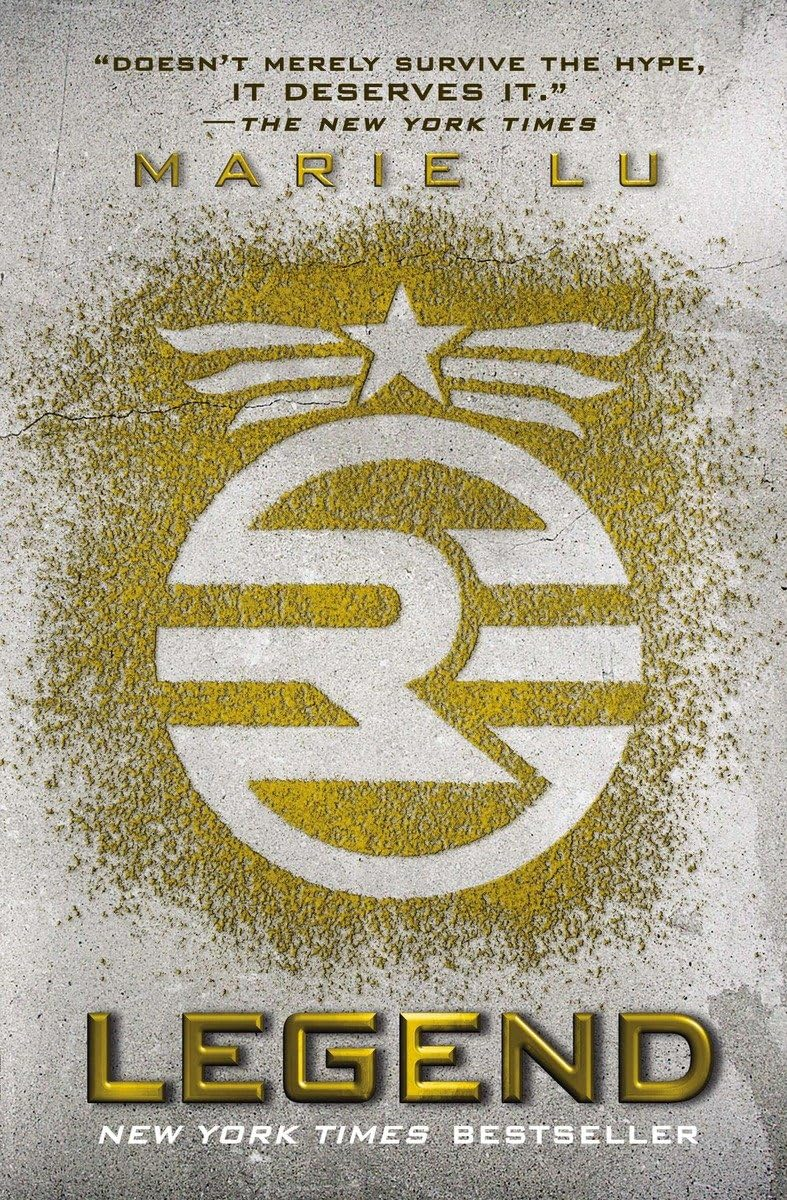
Legend by Marie Lu

Legend, the first book of the Legend series, is a dystopian young adult novel written by Marie Lu. Taking place in the future, the U.S. was battered by floods and destroyed with a massive volcanic eruption. In the midst of the destruction, the Republic of America, run by dictator Elector Primo, arose. In contrast to the totalitarian state, the Colonies of America also formed, countering the Republic’s rule. This dramatic rift of conflict is not the only thing in this novel that is converse.

Day, a 15-year-old boy from the poor Lake sector just outside of Los Angeles (also known as the "slums"), follows a life of crime (ex. torching fighter jets, stealing food and money, running up and vandalizing buildings) against the Republic. On the other hand, June is the Republic’s star prodigy and soldier as she scored a perfect 1500 on the Trials, an intellectual and physical exam given to 10-year-olds to assign them to different social classes. As a result, she lives a life of comfort, with as many Notes (currency) to last her a lifetime and more. Unlike Day’s opposition to the Republic, June pledged her unyielding allegiance to the state. Her goal is to capture the Republic’s most-wanted criminal, Day.


Despite coming from vastly different backgrounds and experiences, Day and June also share major similarities.


  • Both are prodigies. In the novel, it is revealed that Day actually achieved a perfect 1500, instead of the 674 failing score that the Republic lied about.

  • They both seek revenge and have strong loyalty for their families. Day is seeking revenge against the Republic for the brutal murders of his family members (Dad, Mom, John) and the immoral testing of Eden (his younger brother) for biological weapons in war. June is seeking revenge against the person who killed her older brother, Metias. She initially believed that Day was his murderer, but was manipulated by Commander Jameson (a Republic military commander) into thinking that.


Day and June are like magnets; complete opposites (“north” and “south”) that come together to form a strong connection. Though they had a rough history, they try to put their prejudices behind them to expose the corrupt system of the Republic.


- Chloe L.


Monday, January 20, 2025

Goodreads Reviews😱

     Many readers know and love the website Goodreads, the online tool allows for readers to keep track of which books they have read or would like to read. Goodreads was established in 2007 by Otis and Elizabeth Chandler. The website has a feature that allows anyone with an account to leave a review on a book. There are a couple of good aspects to this but just as most things go there are also negative aspects to the review option. Many simply use the feature once they have completed a novel to write their thoughts about it, reviews pile on plenty of different series and books including someone's positive, negative, or neutral thoughts on a book. The thing is though, if someone has strong opinions that are biased based on components such as lack of understanding, influence from others, or even just missing a key detail that adds to the storyline, can cause for the reviews to not be 100% accurate.  

In general society can deem a book good even when some disagree, which can lead to someone looking for a new read to be influenced into reading a book with the opinions of others and not their own. Some of the people deeming these books as good or bad can also be uneducated and lack the important knowledge/information needed to truly understand the book. A prime example could be people who have read something from school, or a parent made them read the book for educational purposes; both of which can cause someone to not enjoy the book as much as what a book of choice could have been enjoyed. With these examples, someone’s lack of enjoyment could simplify down to negative reviews on a book that might be really good. 

 Another thing about reviews is the open space to express emotion and thought, there have been times where I’ll see a series of reviews from Goodreads where someone is being humorous in their review yet still express their thoughts of the book. The free range of words that can be used in a review welcomes people to advise other readers of what to look forward to or even look out for in a story. The process of leaving reviews initiates connections from people in different places to share something that they value with others. That is my take on Goodreads reviews, this might not be true for everyone but in general the ideas of reviews are great when they are unbiased.  

(Bonus if you want! Here's a link to Goodreads: https://www.goodreads.com/)

            -Chloe B.🦆

Monday, January 13, 2025

Fanfiction - Literature or Nonsense - Max B-M

    Fanfiction is defines as "fiction typically written in an amateur capacity by fans as a form of fan labor, unauthorized by, but based on, an existing work of fiction," and while the authors may be amateur at the craft, the work is often far from it. There is an ongoing debate in many fandoms, really every fandom, about whether fan-written works and stories (more commonly known as “fanfiction” or “fanfic”) should be considered true literature. Many websites, from Wattpad to Ao3, are devoted to providing access to fanfiction. These sites vary in publicity (Ao3 requires an invitation to create an account) and general quality of writing. On pretty much every fanfic site, you can find works with the potential to become true published novels next to 100-word stories of absolute nonsense. 

    Now, I know many people who read a lot of fanfic, and I also know many people who would rather die than read some random story about characters from an already-known franchise. Most of the people who do enjoy reading it are often on the side of it being considered “real literature,” believing many of the works are not only long enough but also well-written enough to be published. The ladder, however, is the people who often argue the side of fanfic being unoriginal and “obsessive,” with the belief that it’s almost always poorly written. While these people are occasionally correct, they often aren’t and base their arguments on “crack fics”. 

    Fanfictions that are made with the purpose of being absurd and all-around “bad” are often referred to as “crack fics”. These works are typically created due to a bet, or simply wanting to make something funny and unserious. Using these types of fics as evidence of poor quality isn't honest as they are written to be poor quality. If the fics are bad that means the author has done their job and they aren’t good examples as opposed to truly gross or bad fics. 

    While there are fics that are meant to be bad, there is still some simply bad fan fiction. Usually written by 11-year-old girls about random celebrities they like, these fics are almost always painful to read. They’re typically sickeningly cringe and are simply poorly written, with run-ons and sentences that make little to no sense. However, these fics are often made for other young girls, not people looking to read a truly flushed-out story. Though these works make for a better argument in the fact that fanfic is inherently bad, they are rarely what people talk about when they argue for fanfiction being true literature. 

        What people are typically speaking of when they talk about “good” fanfiction, are the full stories with hundreds of thousands of words. There are many fics that Etsy creators have even begun to bind into physical books. These stories can be the same length as fully published novels, sometimes the length of a full series. “All the Young Dudes” by MsKingBean on Ao3 is 188 chapters and bound copies are sold by many Etsy shops. It’s undeniably well-written and is one of the founding bricks for the “Marauders” fandom, a fandom that wouldn’t exist without fanfics. 

    Many fandoms, actually, are completely founded on fanfiction. Characters that might not exist normally or only have very minor background roles can be given new life with the extensive character building that many fic authors do. There are countless OCs (original characters) that have been created to aid in stories and are then accepted as a widely favored character. 

    These fics are often even the quality of a published novel. Scene building and character profiles are often extensive enough to be categorized as professional, even if they were written on someone's phone in a dark bedroom. These fanfictions will have conflict, resolution, and growth, similar to the traditional way of writing novels. 

    While these works are often without original characters, the personalities, settings, and stories are vastly altered and should be considered as at least mostly, original works. These fics are often beautiful and completely worth reading.  


Anyway thanks for coming to my TED Talk I guess (this was a really weird thing to rant about, sorry y’all) 🫥

Oh My Goodness… Holy Terrors: The end of the Little Thieves Trilogy

  IT’S FINALLY OUT. Well, technically it’s been out for over a month… and I’ve already read it twice, not that I have a problem. Quick warni...